Thursday, March 8, 2012

March 8, 2012

Once again, the time has rolled on by and it has been two months since our last posting. As we explain much of what has been going on with us during that time, it should be clear why it has been hard to get time to do an update...

About a week after our last posting, Julie was asked to "help start off" the new school year at the international school she has periodically taught at during our time in Maun. The school was in a crisis with a number of teachers unable to start working due to work permit cliches. Also, there was a teacher shortage due to a huge influx of students to the school. When she completed term 3 of 2011 with the Standard 1 and 2 classes [grades 1and 2], she was told to order and organize for a combined class of about 15 students. When she was asked to return to start the new school year, she ended up with 41 students in the combined class. The group was one third of the primary enrollment. With two days notice, she had to scramble for supplies, desks, chairs, and reorganize the room to fit that number of students. The larger of the two groups was the Standard 1 students, who are pictured below as they made a "real graph" with the 11 girls and 15 boys for a total of 26.
Then each student made a picture of themselves to place on the "picture graph"wall.
The Standard 2 students did the same math graphing activity, so that we could all see how many boys and girls were in each class.
The Standard 2 group had 9 girls and 6 boys for a total of 15. They also made a picture representation of themselves for a "picture graph" wall on their side of the room.
After a couple of weeks, the Standard 1 teacher was able to take her class and Julie was left to enjoy another month with the 15 Standard 2 students before a teacher could replace her. Some of the students are pictured below on a "civvies" day, when they do not have to wear their regular uniform.The students were busy doing a cooperative learning painting project when these photos were snapped.
Over a couple of weeks, the students had been reading stories with settings at the sea and the seashore, so the group murals they are painting represented that theme.
As the six weeks of "helping start off" the school year came to an end, it was very hard for Julie to leave the students...She is still able to see them weekly though, when returning to teach Bible Club. The picture below is of Julie with the Standard 2 students.
While Julie was teaching, Colin remained busy with his Flying Mission Services responsibilities. The new woman to replace Julie began on the 16th of January. Linda is pictured with Kevin and Patricia while celebrating Patricia's birthday on the 24 the of January.
Colin also flew one of the planes down to Gaborone for maintenance and spent a few days there.
There are now 3 twin engine planes available for charters and mercy flights that are based in Gaborone. Two of the planes are pictured next, while the third was off on a mercy flight.
Mercy flights are almost a daily occurrence, and often with numerous calls for medical transport in a day.
Colin watched as a flight came in transporting a sick child to the larger hospital in Gaborone, the capital city where the FMS base is located.
As January was coming to an end, we were invited to go on a picnic with a group of our close friends one Sunday after church. It is always lovely to get out on the river and see a variety of birds, along with local people fishing in mokoros.
The Kowalski family and Keith's parents were among the people invited.
Also, Angela and Graham along with a number of children they currently have living with them while they children attend school in Maun.

We had picked up some fresh watermelon that is in season now, for our contribution to the food.
It seemed to be a big hit and everyone ate their portion while soaking in the warm river water on that hot summer day.

Little fish could be seen in the clear shallow water, seemingly interested in the watermelon seeds being spit into the river around the boat.
The afternoon rain clouds began to roll in, so it was back into the boat to travel to Maun before the showers started.
In the area of direct ministry outreach, Julie has continued to teach Sunday school regularly and began meeting weekly with the teens to do a foundational Bible study distributed by Flying Mission. Most of the group is pictured below, along with our dear friend Pusetso from Sepopa. Pusetso has been in Maun to get some job training and has been an additional help with translating with the local children attending church. We see this faithful neighborhood group of young adults as the future leaders of the church that we have been attending over the last 4 years.
Cheryl and the Kowalksi kids have been using their ministry gifts to do puppet shows when invited. On Julie's last day of teaching, she asked them to present a story at the weekly chapel for the 128 primary students. The show was very well received by students and staff.
As mentioned earlier, Julie will continue to do a weekly Bible club and will finish the term with help from Cheryl and the Kowalski kids. Cheryl has a number of new songs for the children and Julie to learn...
...in addition to more Bible stories that Jacob and Abigail have to share using puppets.
It has been wonderful to see the physical and spiritual growth that has taken place in the children while doing the weekly Bible club over the last three years. Please pray that someone will be willing to continue to outreach with these beautiful children.

The first weekend in March was quite special in that through months of discussion, prayer, and planning we were finally able to host a Child Evangelism Fellowship [CEF] missionary to do a training session here in Maun. After a full day of travel by bus from Gaborone, Colin searched the new bus rank for our guest.
Once he was found, Colin welcomed Mr. Reuben Akormedie, the regional director for Botswana, who has been ministering here for the last 15 years.
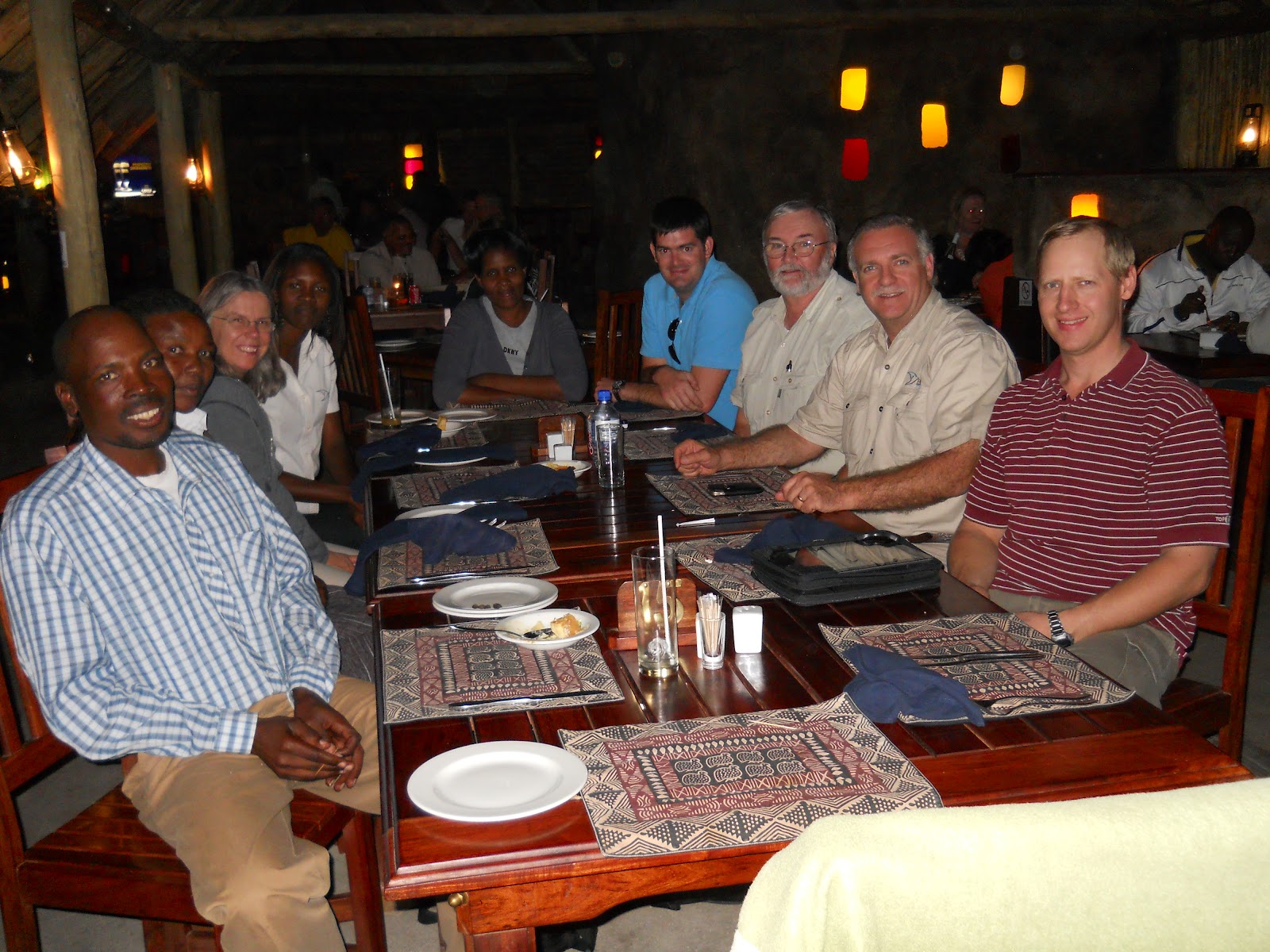
Our missionary friend from Rakops also traveled to Maun with 3 ladies from the preschool program established through his ministry. Everyone stayed with us for two nights, and are pictured next while eating a quick dinner before starting a Friday evening session.
There were 14 people who attended, from a variety of local outreach programs for children. We were able to organize and secure the conference room at Island Safari Lodge for Friday evening and a full day training session on Saturday.
Originally Julie had wanted to see that the Sunday school teachers she had been encouraging and working with, would be connected with someone who could get them more materials. As the plans were coming together for the weekend session, more people wanted to participate as the news spread by word of mouth. All that attended found the time well spent, as they learned new songs and techniques for ministering to children.
The Tswana speakers quickly translated some of the new songs, and shared them with the rest of the group.
Holding the CEF training weekend, and doing the foundational Bible study with the church teens are just a couple of ministry goals we have felt necessary before leaving Botswana. There are still a couple other areas we had hoped to see through before leaving, but our time is growing very short. One thing we had wanted to do was make a final trip to Sepopa to do a special activity with the children there. People have been asking Pusetso when we are coming back, and it would be nice to see those people we have been able to encourage there...Unfortunately, our Pajero has been in the shop since the 25th of January. The main delay has been securing the correct parts...Please pray that we might be able to make a trip there before our departure. Our time is Botswana has been such a blessing. We have found the people so open and eager to hear the truth of the gospel, and we feel all of our professional, spiritual training, and gifts have been fully used.

As we begin to pack and make plans to return to Alaska, we are still not sure where our next home will be. We are hoping to resettle on the road system, so we can be near friends and our son who is living in Fairbanks. Though that is our hope, we are keeping in mind that God may have another plan for us...so we will keep in mind to, "Commit your way to the LORD; trust in Him and He will do this." Psalm 37:5

Friday, January 6, 2012

January 6, 2012

When our last blog ended, we mentioned that we were heading to Mozambique shortly...We had been given an invitation to visit some friends that used to live there, and return every year for a few months to continue a turtle research project they started 17 years ago. Knowing that our time in Botswana is quickly nearing an end, the opportunity for a last major trip was more than we could refuse. We would also use this opportunity for our thirtieth wedding anniversary celebration trip. Flights with FMS were slowing and we saw that there was a brief window of time open to get away for the ten day trip.

Julie finished teaching on Friday the 9th of December and at 5am the next day we were on the road headed for South Africa. The Limpopo River divides Botswana and SA. The border post we went through on the way down sits on the Limpopo river which has been famous throughout southern African history, but became even more well known when Rudyard Kipling wrote a short story called The Elephant's Child. In the story the river is repeatedly referred to as "the great gray-green, greasy Limpopo River, all set about with Fever trees." We checked out of Botswana and found that there was a one lane bridge to cross the river.
The next photo shows the river, so descriptively portrayed in Kipling's narrative.

On the other side of the river was the South Africa post. After going through the appropriate procedures to continue on our way, we went to use the public toilets and were amused to see the following sign...only in Africa.
Not knowing the road conditions or how many kilometers we could travel a day, we did not make any overnight plans before our departure. The first day we got as far as Potgietersrus just before dark and realized it was a rather rough place to stay. Not wanting to travel after dark and unsure of what was ahead, we felt fortunate to find a decent hotel on the edge of town. There was a secure parking lot for the night with a guard, and the room was clean. The only problem was the loud music from a wedding reception that went on until almost 2am. It really felt like an oasis when we discovered the hotel pictured below, though we would not categorize it as "luxury accommodation".
Our plans were to get to southern Mozambique on the second day of travel, but we realized later the next day that the border closed at 5pm and trying to find our friend's place with somewhat sketchy directions in the dark, did not appeal to us. So, after a long drive up over a very steep mountain we found a lovely lodge overlooking a man made lake near the town of Jozini. We inquired about rates, and then negotiated for a discount given to people who live in southern Africa. The Tiger Lodge was built on the side of a hill and is pictured next, and we really did get an affordable night in "luxury accommodation" while staying there.
Our room
Pictured below is the view from our room with the Jozini dam in the distance.
Early on our third day, we proceeded through Jozini. It seemed like a typical African town with lots of vendors setting up shops by the side of the road.
To continue, we had to cross the Joziniz dam. We parked to take a better look, and the picture below is of the back side with water that flows on through a narrow valley.
Looking back down the valley
Crossing the top of the dam.
The next photo is from the top of the dam looking at the Tiger Lodge where we had just spent the night.
In between the rural huts along the way, there were a few additional small towns like Jozini. The last place to get fuel and food before the border was a place called Mangusi. Of course there were more roadside vendors and people walking all about.

The SA and Mozambique border was small and primitive. As soon as we crossed into Mozambique, the tar road ended. The sand-track road pictured next is the main highway. Our friend's camp spot was 20 kilometers past the border.
The next picture is our first view from the highway, of the Indian Ocean and beachfront.
After a bit of searching and asking local people where to find our friends, we discovered that they were not staying at their yearly camp spot beside the beachfront where we had planned to camp with them. Instead, they were actually house sitting for a couple of weeks in a huge house that overlooked the beach. Not only had the offer been an unexpected blessing to them, but also to us as there was more than enough room for all four of us. Pictured below are our friends, Pierre and Yvonne, as we had lunch after we arrived.
The house was a two story, five bedroom place on a hill overlooking the beach. There was also a pool. It was absolutely beautiful.
The view from our upstairs bedroom is pictured below.
It was just a short walk down the hill to the beach. The next photo is looking down the beachfront from in front of the house on the beach.
All over the beach there were little ghost crabs coming and going with the surf.
A close up of a ghost crab pictured below.
Our friends are very committed to the turtle research they started years ago. Not only were we able to enjoy daily visits with them, but we also truly enjoyed helping with their work at night. No motorized vehicles are allowed to drive on the beach except our friends while out tagging turtles.
Two hours before low tide, we would depart for the 30 kilometer drive up the beach in search of female turtles crawling from the water to lay eggs above the high tide mark. There are two types of turtles that are prevalent to nesting in the area. They are the Loggerhead and the Leatherback turtles. The one we saw the most was the Loggerhead turtle and is pictured below.
When we came upon a turtle, it was tagged, measured, and the location was recorded. If you look closely at the next picture, there is a tag on the right front flipper of the turtle.
The Loggerhead pictured below had just finished camouflaging her nest and Pierre was quickly getting her measurements. Notice the sand covering part of her shell from kicking sand all around her buried eggs.
Even if a turtle had already made a nest and returned to the water, the GPS location was documented. As we discovered turtles nightly, we had to be careful not to disturb the females while they were digging a nest. Once they started laying their eggs, the females would go into a trance like state and we could even watch the eggs being dropped. Below is a Leatherback turtle in the process of laying her eggs.
There were a few lodges and housing developments for the first 10 kilometers of our beach drive. One night there were some tourists from a lodge out looking for nesting turtles, when we all came to a Leatherback turtle at the same time. Pierre was so good at educating them about the turtles and took the time to explain the research work they were doing in Mozambique.
The next few pictures may give a perspective of how large the Leatherback turtles are.


The last 20 kilometers of beach was in an elephant reserve and extremely deserted. It was so beautiful to be out in the middle of the night, with a full moon glistening over the waves as they crashed ashore. We felt so privileged to have been a part of such an exceptional project and experience.

One day we did travel to the nearest town of Pondo De Ouro to get diesel for the truck and go to the local market. There was actually a good variety of items available in all the vendor stalls.


Later we stopped at local eating place before returning home. There was not much variety on the menu, but the food was excellent. We asked someone to take a picture of us all together by a road sign on the main road. It says "12km to Kosi border" and "674 to Johannesburg". Also, notice the "Eskimo Ice" sign.
When we finished lunch, we went to check on some things at the property our friends own. They are part owners in a resort where they usually camp while doing the turtle research. The next photo is looking up the beachfront from their property.
We had four full days and nights with our friends, before setting off to spontaneously explore the Rorke's Drift area of SA. Along the way, we spotted another sign to add to our road sign collection. This one is a hippo crossing sign.
The Mozambique border only opened at 8am, so we got a later start than we would have liked...Again as the evening approached, we were uncertain of the road conditions or how many kilometers we still had to go before reaching our destination. Colin, a meticulous navigator and planner, was very brave about all this spontaneous driving. Entering another rather rough looking town, we found the Golden Reward Inn. It looked clean and fairly safe, but it was certainly different. The ceiling was stalactite textured and there was no seat on the toilet among other things.

The place did have a TV to distract us though...and we were again thankful to have a safe place to stay. We think the half star inn we stayed at that night, was meant to really help us appreciate the lodge we discovered the next day. Venturing into the Zulu battle field area of SA on our way to find Rorke's Drift, there was a lovely lodge built up on a hillside overlooking the area of the Isandlwana battle field [pronounced "eye sand wana"]. Once again we inquired about rates and then negotiated for a discount, which made a two night stay very reasonable.The front walk up to the lodge is pictured below.
This is the view from the backside of the lodge. Our room was located on the second level below the decking pictured.
Our room
The view from our room was of the Isandlwana battle field. Note the small hill on the right at the horizon that is Isandlwana. Most of the battle took place to the left of the hill.
All the little while dots in the picture below are rock cairns marking the graves with 5 or more British soldiers each, that died during the Anglo-Zulu war on the 22nd of January 1879. This little photo does not even touch how vast the graves are scattered across the hillside. This battle between the British and the Zulu saw about fourteen hundred British, the whole encampment, wiped out. Later that afternoon the Zulu attacked the Rorke's Drift encampment, a battle made famous by the 1965 movie Zulu. This battle pitted one hundred forty British soldiers against four thousand five hundred Zulu warriors with the British prevailing. The Isandlwana battle was the equivalent of the American battle at Little Bighorn.
Close up below of Isandlwana
We were too late for the tour of the Isandlwana battle field in the morning when we arrived, but after lunch we were able to go on the tour to Rorke's Drift. The battle at Rorke's Drift was a continuation of the battle that happened at Isandlwana, so our guide gave us a brief overview of the events leading up to the next Zulu attack that took place that same day at Rorke's Drift in 1879.

Our guide was named Robert Gerrard, and he has keenly studied the historical battles of the area since 1
971, and has lived at Isandlwana since 1995. We purchased one of his books and he is described as, "an extraordinary passionate man with a voice that rolls and resonates as he walks you across the killing fields." We can honestly say that certainly was true. Rob is pictured below as we stopped at the Buffalo River where many men trying to escape from Isandlwana to Rorke's Drift were drowned.
The next picture shows what is currently the Rorke's Drift museum, but it was originally the first missionaries' house. When taken over by the British, the house was turned into the hospital. On the left edge of the picture can be seen the church, which in 1879 was turned into a storehouse by the British soldiers. Two hundred pound bags of mealies [corn meal] were used to build four foot tall walls connecting these two buildings when the soldiers were given one hour notice of the coming Zulu attack. The church is now again an active church and has been for many years.
Below is a picture of the church taken from the museum.
Below is a scene from inside the museum depicting the battle.
The next picture is of the rock ledges that overlook the hospital and storehouse. The Zulu were able to fire down on the soldiers from there with guns taken from the Isandlwana massacre earlier.

Robert is speaking behind the hospital/museum in the photo above, and pictured below at the grave site on the grounds. Only fifteen soldiers were lost at Rorke's Drift while six hundred Zulu died. Both battlefields are solemn places.
The next photo is of the Zulu memorial depicting a leopard laying on and guarding the shields of the fallen Zulu.
After breakfast the next day, we were off for a private tour of the Isandlwana battle field with our guide, Rob. Julie is pictured below in the lodge dining room at breakfast.

Above is Isandlwana with a memorial and some rock cairn grave markers. Below is more of the battle field as seen from up on the side of Isandlwana.
Below, Isandlwana at sunset
During our time on the tour with Rob, we were very moved by the intense description he wove and the historical significance of the events that took place on the grounds we walked. The time spent there was incredibly powerful, and extremely memorable.

Around the lodge living in the rocky cliffs, were numerous Rock Dassies. Though vegetarians they are not rodents. Much of their digestive system and body parts closely relate them to elephants. They are equipped with canine teeth and can bite but are very easy to tame.

Colin also enjoyed seeing fine looking Naguni cattle that were grazing along the road to Rorke's Drift. For you farmers, Naguni cattle are named after the Naguni tribe that were found raising them in eastern South Africa. They have several unique pattern and colored hides. Colin likes the steel blue shade the most, and had to take a picture of the excellent example in the next photo. The Zulu warrior groups each took a different hide color and pattern for their shields to depict their unit. The Naguni are very resistant to ticks and other bugs and can live off bush and grass during droughts while other cattle types would die.
It was interesting to see how differently the Zulu people in the area put thatch roofs on their huts. The design seemed more elaborate than what we have seen in Botswana.
Leaving Isandlwana on the 19th of December, we had a 12 hour drive to get to Gaborone for our FMS Christmas party the next day. Along the way, we stopped to look at some grass mats the woman in the next picture was selling. The mats were lovely, but we really could not justify buying something. As a consolation, we bought some of her pineapples.

Arriving in Gaborone, we were met by Patricia, MT, and MT's wife KK who all traveled down from Maun by bus that same day. The next day we did a few errands around the city and then headed off for the FMS Christmas party that evening.
It was a great gathering and good to see the rest of our coworkers with FMS.
Pictured below are Mark and Deb Spicer, our Godly and fearless leaders...
The Kowalski family had travel plans with Keith's parents visiting, and Kevin was keeping everything at the base together while we were all away. The picture below is of those of the Maun team that could make the festive event.

A variation from other years when it was a potluck gathering, was that this year's Christmas party was a catered dinner. It was especially nice for us that traveled, as it is difficult to cook when you are in transit.
There was also sort of a gag "prize giving" with certificates such as "Drinks the most coffee", etc. Some were a little more serious, and Patricia got an award for always being cheerful and optimistic.
We left Gaborone by 6am, so that we could be assured to do the ten hour drive in the daylight. Just about 2 hours into our trip, the small car traveling in front of us hit a female Kudu that seemed to jump out into the road from nowhere. We were the first to stop and Colin attended the two passengers that had head injuries, while Julie was able to contact emergency services. We stayed until professional help arrived.
There were four people in the car and they were very fortunate. The driver lost control of the car when the Kudu went into the windshield, causing the car to cross into the oncoming lane and then go off the road almost hitting a tree. We thought the car was going to roll, but it spun around and came to a stop where it is pictured below.
By the time we returned to Maun, Christmas was just about here. The travels helped distract us from the fact that it is another year we are away from our family and friends in the states. It really helps that we have become a family with our team mates, the Kowalski family. This year, as mentioned before, Keith's parents were visiting and we were blessed to spend Christmas Eve with the whole Kowalski clan. Keith's folks are pictured relaxing next to all the family gifts in the corner.
Julie always enjoys getting some time with Lily.
After dinner, we sang Christmas carols with Cheryl, Jacob and Abigail.
The next morning we went to Church, but were disappointed that the annual gift give away for the local children had been the Sunday before. The churches Indian community wanted to prepare a meal for the church the week before, and our Pastor was traveling for the holiday, so the event took place while we were traveling. There were over 65 children at church Christmas Sunday, and we were able to share small bracelets and bubble gum sent from a friend in the states. We were too busy to get any photos...Later that day, we had Christmas dinner with Kevin, our pilot and neighbor.
On New Year's Eve, we had a quiet evening at home. After church on New Year's day, we spent a wonderful afternoon and evening with many of our closest friends at Island Safari Lodge. We were so engaged in visiting, that we forgot to snap any pictures to keep as memories. Even without taking any pictures, it was such a lovely way to start off 2012, that the day will not easily be forgotten in the years to come.

We thought we would conclude with a few pictures of "everyday things" you deal with when living in Maun. Every year during the rainy season there are more bugs around, and every year some type of bug or worm seems to invade us for a few days. This year there were moths everywhere. When we walked out our door or across the lawn, they would fly up all around us. Fortunately it only lasted a few days...
Shaded parking for cars along the road...
Shaded parking for donkeys along the road...
People here and over in the states, keep asking us what our plans are. At this point we just know for sure that we will go back to Alaska, not that we really want to go back to fighting all that harsh weather after 4 years in a warm climate, but there are things we feel we need to go back to do. It was not easy to leave the incredible memories and friends from our years in Alaska, but now we are struggling with intense emotions about leaving Botswana. We ask that you pray for God to reveal our next steps, because "prayer is a way for us to connect to God's plan. It is not about figuring a way to get God into our plan..." from The Beauty of God's Blessings. So, we will continue to wait and "Stand fast in the Lord." Phil. 4:1